ARTÍCULOS APOLOGÉTICOS
Biblioteca de Artículos
Análisis profundos, investigaciones y respuestas apologéticas a las críticas contra la fe católica.
Conocimiento Católico Profundo
Nuestros artículos proporcionan análisis rigurosos de doctrinas católicas, respuestas a objeciones protestantes, investigaciones sobre controversias eclesiásticas, y reflexiones teológicas basadas en el Magisterio de la Iglesia.
Contenido Riguroso
Basado en fuentes magisteriales
Actualizado
Nuevos artículos regularmente
Accesible
Fácil de entender y compartir
Todos los Artículos

Análisis Apologético
Análisis Profundo: German Synodal Way Continues to Face Vatican Scrutiny Over Doctrinal Issues
The German Synodal Way, viewed through a deep theological lens, represents a profound crisis of *anamnesis* – a forgetting of the Church's constitutive memory and identity. It is a manifestation of what Henri de Lubac termed 'neo-Gnosticism,' a perennial temptation within Christianity to replace the objective, revealed truth of the Incarnate Word with a subjective, immanentized 'gnosis' derived from human experience, societal pressures, and intellectual trends. This perspective posits that the Synodal Way is not merely seeking 'reform' but a fundamental re-constitution of the Church based on an anthropocentric rather than a Christocentric understanding of reality. It is a shift from an ecclesiology of *reception* (receiving divine truth and grace) to an ecclesiology of *production* (producing truth and meaning from within human consensus). The core theological error lies in its implicit denial of the *transcendent objectivity of revelation* and the *supernatural character of the Church*. When the Church's doctrines on priesthood, marriage, and celibacy are subjected to the litmus test of contemporary societal acceptance or individual subjective fulfillment, they cease to be divine truths to be faithfully transmitted and become mutable human constructs to be adapted or discarded. This perspective understands the Synodal Way as a tragic illustration of the temptation to 'democratize God,' to conform the divine to human categories rather than allowing the divine to transform human categories. It is a surrender to the 'spirit of the age' over the Holy Spirit, leading to an inevitable theological fragmentation and a loss of the Church's prophetic voice to a world desperately in need of transcendent truth, not merely a reflection of its own desires. The true apologetic response, therefore, must be a robust re-assertion of the *scandal of particularity* of Christ's revelation and the *scandal of authority* of the Church as its divinely appointed custodian, reminding us that the Church's fidelity lies not in its relevance to the world, but in its unwavering fidelity to Christ, who alone is 'the way, the truth, and the life'.
6 mar 2026
Leer artículo
Análisis Apologético
Análisis Profundo: African Bishops Express Concerns Over 'Fiducia Supplicans' Implementation
The theological perspective emerging from the African bishops' concerns about *Fiducia Supplicans* is one rooted in a profound understanding of the Church as the Body of Christ, both universal and particular, animated by the Holy Spirit, yet navigating the complexities of human cultures and the enduring reality of sin. It is a perspective that emphasizes the *coherence of revelation* as paramount, asserting that divine truth, particularly concerning human sexuality and the nature of marriage, is not subject to reinterpretation or significant modification based on evolving societal norms. This view holds that the *depositum fidei* is a unified, organic whole, where pastoral charity, while essential, must always be tethered to theological clarity and the unwavering proclamation of the truth. It underscores a *sacramental anthropology* where human actions, particularly those involving blessings, carry immense symbolic and ontological weight, not easily decoupled from their inherent meaning or the moral status of their object. From this perspective, a blessing is not merely a benevolent wish but an invocation of divine favor that implicitly affirms the blessed reality's consonance with God's will and its trajectory towards holiness. The African perspective also highlights a robust *ecclesiology of inculturation*, where the Gospel is received and lived within specific cultural matrices, shaping a *sensus fidei* that is deeply communal and attuned to the practical implications of theological pronouncements. It views the local episcopal conference not merely as an administrative unit, but as a vital guardian of the faith, uniquely positioned to discern how universal directives can be authentically applied without causing scandal or undermining the integrity of the Church's moral teaching among its faithful. This perspective, therefore, is a powerful reminder that true synodality involves not just listening, but a profound theological discernment that respects the diverse ways in which the Holy Spirit guides the Church across the globe, ensuring that unity in faith is maintained without sacrificing the clarity of truth for the sake of a perceived, but potentially ambiguous, pastoral accommodation. It is a call for the Church to reaffirm its prophetic voice, courageously proclaiming the unchanging truth of the Gospel, even when it challenges contemporary sensibilities, while always extending genuine love and mercy to all.
6 mar 2026
Leer artículo

Análisis Apologético
Análisis Profundo: Pope Francis's Comments on Priestly Celibacy and the Diaconate for Women
The theological perspective underpinning Pope Francis's statements is one of profound 'Christological-Pneumatic Coherence' within a 'Sacramental-Eschatological Anthropology.' This perspective posits that the Church's life and structures are not merely human constructs but are divinely instituted and animated by the Holy Spirit, always oriented towards the ultimate fulfillment of God's plan in Christ. The 'Christological' dimension insists on fidelity to Christ's unique identity as Head and Bridegroom, and the 'Pneumatic' dimension emphasizes the Holy Spirit's ongoing guidance in discerning how best to live out this fidelity in time. This coherence is expressed through a 'Sacramental Anthropology' that understands human personhood in relation to the sacraments as channels of grace and signs of divine reality, where gender is not incidental but integral to sacramental sign-value in certain contexts. Finally, an 'Eschatological' lens views all ecclesial practices and doctrines as pointing towards the Kingdom of God, either as prophetic signs (like celibacy) or as constitutive elements of the new creation (like the sacraments). This perspective avoids reducing the Church to a socio-political institution, instead affirming her as a mystical body, a sacrament of salvation, whose internal logic is rooted in divine revelation and whose ultimate purpose is the glorification of God and the salvation of humanity.
6 mar 2026
Leer artículo

Análisis Apologético
Análisis Profundo: The Ongoing Debate and Implementation of 'Fiducia Supplicans' on Blessings for Same-Sex Couples
The theological perspective underpinning *Fiducia Supplicans* is a profound re-articulation of the Church's identity as a 'sacrament of salvation' (Lumen Gentium, 1), not merely a dispenser of sacraments. It is rooted in a robust Christology that emphasizes the radical inclusivity and transformative power of divine mercy, echoing Christ's own ministry to those on the margins. This perspective understands grace not primarily as a reward for righteousness, but as the divine initiative that *enables* righteousness and draws humanity towards its ultimate eschatological fulfillment in God. It posits a pneumatological understanding of pastoral action, where the Holy Spirit inspires acts of compassion and accompaniment that transcend rigid juridical categories, fostering genuine encounter and conversion. The document recovers an ancient, often obscured, distinction between liturgical blessings that sanctify a 'state of life' and non-liturgical blessings that invoke divine aid upon 'persons in their concrete situations,' acknowledging their inherent dignity and their often-unarticulated yearning for God (the *status viatoris*). This is not a doctrinal shift but a hermeneutical re-orientation, prioritizing the *salus animarum* (salvation of souls) through a 'hermeneutic of mercy' that complements and illuminates the immutable 'hermeneutic of truth.' It recognizes that while objective moral truth remains constant, the Church's pastoral approach must be dynamically adaptive, incarnational, and discerning, always seeking to build bridges of grace rather than walls of judgment, thereby fulfilling its mission as a 'field hospital' for a wounded world.
6 mar 2026
Leer artículo

Análisis Apologético
Análisis Profundo: Pope Francis's Apology for Using a Derogatory Term Towards Gay Men
This incident is best understood through a Christological-Ecclesiological lens, specifically emphasizing the 'wounded healer' paradigm and the 'already but not yet' eschatological tension of the Church. The Pope, as Vicar of Christ, is called to embody Christ, yet remains a human being susceptible to sin and cultural conditioning. His office, while divinely instituted and possessing unique charisms (like infallibility under specific conditions), does not deify the man. The Church itself, as the Mystical Body of Christ, is simultaneously holy and in need of purification, a 'hospital for sinners' rather than a 'museum of saints.' This perspective acknowledges the profound mystery of God working through imperfect instruments, revealing His power most perfectly in weakness (2 Cor 12:9). The scandal, therefore, is not a refutation of the Church's divine origin but a stark manifestation of its human reality, forcing a deeper reliance on Christ's grace and a renewed commitment to charity and truth, even in the face of internal failings. It underscores the cruciform nature of truth – that profound insights and purifications often emerge from moments of apparent brokenness, mirroring Christ's path through suffering to glory. The Church's enduring capacity to self-correct, to apologize, and to continue its mission despite such human failings, is itself a profound sign of its divine guidance, demonstrating that its ultimate authority and holiness derive from Christ alone, not from the impeccable conduct of its members or leaders.
6 mar 2026
Leer artículo

Análisis Apologético
Análisis Profundo: German Synodal Way's Continued Push for Reforms Despite Vatican Warnings
The German Synodal Way, viewed through a deep theological lens, represents a profound eschatological tension within the Body of Christ, a manifestation of the ongoing struggle between the *Civitas Dei* and the *Civitas Terrena*. It is not merely a localized pastoral debate but a universal theological crucible, testing the Church's fidelity to its own supernatural identity in an increasingly secularized world. The core theological perspective is that the Church, as the Mystical Body of Christ, is not an institution subject to human redesign based on prevailing cultural norms or sociological pressures, but a divine organism, whose essence, structure, and mission are divinely instituted and safeguarded by the Holy Spirit. The Synodal Way's proposals, particularly on sexual morality, women's roles, and priestly celibacy, inadvertently challenge the Church's foundational Christological anthropology, its sacramental ontology, and its pneumatological understanding of Tradition. This perspective posits that true reform in the Church is always a *ressourcement*, a return to the sources of divine revelation (Scripture and Tradition), and a deeper conversion to Christ, rather than an accommodation to the spirit of the age. The Vatican's warnings are understood not as authoritarian repression but as a necessary exercise of the Petrine charism, safeguarding the unity of faith and morals, which is indispensable for the Church's salvific mission and its eschatological witness. The ultimate theological defense lies in re-affirming the Church's identity as the Bride of Christ, whose teachings are not arbitrary rules but the liberating truth revealed by God for human flourishing and eternal salvation, a truth that transcends and often stands in prophetic opposition to the ephemeral wisdom of the world.
6 mar 2026
Leer artículo

Análisis Apologético
Análisis Profundo: Ongoing Fallout from 'Fiducia Supplicans' and Diocesan Interpretations
The theological perspective emerging from the *Fiducia Supplicans* controversy is one of profound eschatological tension, revealing the Church as a pilgrim people continually navigating the 'already and not yet' of the Kingdom. This tension is not a defect but an inherent characteristic of the Church's nature as both divine institution and human society, a 'sacrament of salvation' perpetually striving to embody the fullness of Christ in a fallen world. The core theological insight is that the ongoing fallout is a crucible for discerning the true nature of *kénosis* – both Christ's self-emptying and the Church's participation in it. The Church, in its pastoral zeal, attempts to reach out in mercy, but in doing so, risks a form of institutional *kénosis* that, if not carefully guarded, could empty its doctrines of their salvific content. The resistance, particularly from those who live the Gospel in contexts of acute moral and spiritual struggle, serves as a prophetic counter-kénosis, a re-assertion of the *pleroma* – the fullness of truth and grace – that must always accompany and inform the Church's merciful outreach. It is a reminder that true mercy is always tethered to truth and calls for conversion, rather than merely affirming existing states. The controversy thus forces a re-evaluation of the relationship between divine love (agape) and divine truth (aletheia), affirming that they are not separable but co-inherent, with truth being the very structure of love. The Church's ultimate *telos* is not merely to offer comfort but to lead souls to sanctification and eternal life, a mission that demands unwavering fidelity to the ontological reality of human nature, marriage, and the transformative power of grace, even when such fidelity is perceived as 'unmerciful' by a world that has lost its way.
6 mar 2026
Leer artículo
Teología
La Roca Inquebrantable: La Cátedra de Pedro como Eje Irrefutable de la Unidad Eclesial
Este artículo desentraña la doctrina de la autoridad papal no como una invención humana o una mera figura histórica, sino como el designio divino inmutable, la piedra angular sobre la cual Cristo edificó su Iglesia. A través de una exégesis rigurosa de las Escrituras, el testimonio ininterrumpido de la Tradición y la enseñanza perenne del Magisterio, se demuestra que la Sede de Pedro es el garante insustituible de la fe, la moral y la comunión, el faro que guía a la Esposa de Cristo a través de las tempestades de la historia. No es un poder arbitrario, sino un servicio supremo a la verdad y a la unidad, arraigado en la promesa divina y manifestado en la vida milenaria de la Iglesia Católica.
6 mar 2026
Leer artículo

Análisis Apologético
Análisis Profundo: German Synodal Way continues despite Vatican concerns
The German Synodal Way, when viewed through the lens of a robust Sacramental-Pneumatological Ecclesiology, reveals itself not merely as a pastoral initiative but as a profound theological crisis concerning the very *esse* and *bene esse* of the Church. From this perspective, the Church is understood not primarily as a human organization or a democratic assembly, but as the enduring, visible sacrament of Christ's presence in the world, animated by the Holy Spirit. Its structure, its sacraments, and its moral teachings are not arbitrary human conventions subject to societal trends, but rather divinely instituted forms and truths, given by Christ and safeguarded by the Spirit, essential for salvation. The Synodal Way's resolutions, particularly on women's ordination and LGBTQ+ issues, represent a fundamental divergence from this ecclesiological understanding. They implicitly posit a Church whose identity is primarily shaped by human experience and contemporary cultural demands, rather than by its transcendent origin and eschatological destiny. This perspective views the Church as a living organism, whose life is sustained by fidelity to the *depositum fidei* (the deposit of faith), which is not a static archive but a living Tradition, dynamically unfolded by the Holy Spirit under the guidance of the Magisterium. The Synodal Way's approach, conversely, appears to privilege a 'hermeneutic of rupture,' where the *sensus fidelium* is elevated to a constitutive, almost magisterial, authority capable of generating new doctrines or overturning perennial ones, thereby transforming the Church from a recipient of divine revelation into a generator of human consensus. This ultimately risks desacralizing the Church, stripping it of its unique supernatural identity and reducing it to a mere societal institution, thus undermining its salvific mission and its capacity to be a credible witness to the transformative power of Christ in a secularized world. The Vatican's interventions, from this perspective, are not acts of authoritarianism but rather a paternal solicitude for the integrity of the Church's pneumatic constitution and its Christological identity, ensuring that the Body of Christ remains faithful to its divine Head and its mission as the universal sacrament of salvation.
6 mar 2026
Leer artículo

Análisis Apologético
Análisis Profundo: Pope Francis's Comments on Priestly Celibacy and Women Deacons
The theological perspective underpinning Pope Francis's statements is rooted in a profound pneumatic-Christological anthropology and a robust understanding of sacramental economy. It posits that the Church's discernment is guided by the Holy Spirit (pneumatic) in fidelity to Christ's institution (Christological), which shapes human identity and roles within the Body of Christ. This perspective emphasizes that the ministerial priesthood, including the diaconate, is not primarily a functional office but an ontological configuration to Christ the Head and Bridegroom, whose male humanity is integral to the sacramental sign. Consequently, while disciplinary practices like celibacy, embodying a charism, can be prudentially adapted for the good of souls and the flourishing of the ministerial gift, the essential forms and recipients of the sacraments, particularly Holy Orders, are matters of divine constitution and immutable revelation, falling outside the Church's authority to change. This framework highlights the Church's role as a faithful steward of divine mysteries, acknowledging the limits of its own legislative power in the face of Christ's foundational institutions, thereby affirming the objective reality of grace and the sacramental order over subjective human preferences or cultural pressures.
6 mar 2026
Leer artículo

Análisis Apologético
Análisis Profundo: Vatican Doctrine Office Publishes Norms for Discernment of Supernatural Phenomena
The theological perspective underpinning the DDF's new norms is rooted in a profound understanding of the *analogia fidei* and the *eschatological tension* of the 'already and not yet.' It is a perspective that simultaneously affirms the radical freedom of God to intervene in history through extraordinary means, while rigorously upholding the *sufficiency and definitiveness of the Public Revelation in Jesus Christ*. The Church, as the living Tradition, understands itself as the divinely appointed custodian and interpreter of this definitive Revelation. Therefore, any alleged supernatural phenomenon, whether an apparition, vision, or miracle, must always be understood as subordinate to, and illuminating of, this singular, salvific event of Christ. The norms reflect a theological anthropology that acknowledges humanity's inherent yearning for the transcendent and the numinous, a yearning often heightened in times of societal upheaval or personal crisis. However, this anthropology is tempered by a profound awareness of human fallibility, susceptibility to delusion, psychological projection, and even the malevolent influence of diabolical forces. Thus, discernment is not merely an intellectual exercise but a spiritual battle, requiring prudence, humility, and a deep reliance on the Holy Spirit's guidance within the ecclesial framework. The DDF's move is a re-assertion of the *sacramentality of the Church itself* as the primary and ordinary means of grace and encounter with God. While God can and does act extraordinarily, these acts are always integrated into, and never supersede, the ordinary sacramental economy established by Christ. The norms implicitly correct any tendency towards a 'spiritual bypass,' where the faithful might seek sensational private revelations over the communal, liturgical, and sacramental life of the Church. This perspective emphasizes that the Church, as the Mystical Body, is the 'primordial sacrament,' the visible sign and instrument of God's saving grace, and all other graces flow from and through it. Furthermore, the norms are deeply informed by an *ecclesiology of communion and subsidiarity*. While the universal Church, through the DDF, provides the overarching hermeneutic and theological framework for discernment, the primary locus of initial discernment is placed upon the local bishop. This acknowledges the particular Church's unique charism and responsibility, recognizing that the Holy Spirit often speaks first in the particular before being affirmed by the universal. This is not a devolution of authority but a sophisticated understanding of how the Spirit works within the diverse yet unified Body of Christ, fostering a more mature and responsive local ecclesial leadership. Finally, the theological perspective is deeply pastoral, prioritizing the *salus animarum* (salvation of souls) above all else. The rigor of the discernment process, the caution against premature declarations, and the emphasis on the 'fruits' of a phenomenon are all geared towards protecting the faithful from error, delusion, and spiritual harm, while simultaneously fostering genuine spiritual growth and adherence to the authentic faith. It is a maternal solicitude that guards against both uncritical credulity and cynical skepticism, guiding the faithful towards a balanced and mature engagement with the mysteries of faith and the enduring reality of God's active presence in the world.
6 mar 2026
Leer artículo

Análisis Apologético
Análisis Profundo: Pope Francis Affirms 'Fiducia Supplicans' Amidst Ongoing Resistance
The theological perspective underpinning the Pope's defense of *Fiducia Supplicans* is rooted in a profound Christocentric pneumatology, an ecclesiology of encounter, and an eschatological vision of mercy. It posits that the Holy Spirit, the animating principle of the Church, continuously guides the People of God into a deeper understanding of Christ's salvific mission, particularly in its application to the complexities of human existence. This perspective emphasizes that divine grace is not merely a reward for the virtuous but a prevenient, transformative power that seeks out the broken, the marginalized, and those in 'irregular' situations, not to affirm their sin, but to draw them into the *koinonia* of Christ's redemptive love. It views the Church as a 'sacrament of salvation' whose primary mode of operation is merciful accompaniment, extending a radical hospitality that mirrors Christ’s own engagement with sinners. This is an ecclesiology of the 'field hospital,' where the Church’s mission is to tend to wounds, to offer healing and hope, recognizing that the journey towards full moral rectitude is often a gradual process, nurtured by grace. The eschatological dimension is crucial: the blessing, in this context, is a sign of the Kingdom 'already but not yet,' a foretaste of the divine embrace that awaits all who turn to God, a proleptic act of mercy that anticipates the ultimate transformation of all things in Christ. It is a call to trust in the boundless efficacy of God's grace, which can operate even in the most challenging human circumstances, always oriented towards conversion, sanctification, and the ultimate glory of God.
6 mar 2026
Leer artículo
Teología
La Cadena Inquebrantable: La Sucesión Apostólica como Garantía Divina de la Gracia Sacramental
Este artículo defiende con rigor teológico la intrínseca e inmutable conexión entre la sucesión apostólica y la validez de los sacramentos católicos, demostrando que esta cadena inquebrantable, establecida por Cristo mismo, es la única vía segura para la dispensación de la gracia divina. Se refutan las objeciones con la autoridad del Magisterio, la Escritura y la Tradición, afirmando la certeza de la fe en la perennidad de la Iglesia.
6 mar 2026
Leer artículo
Teología
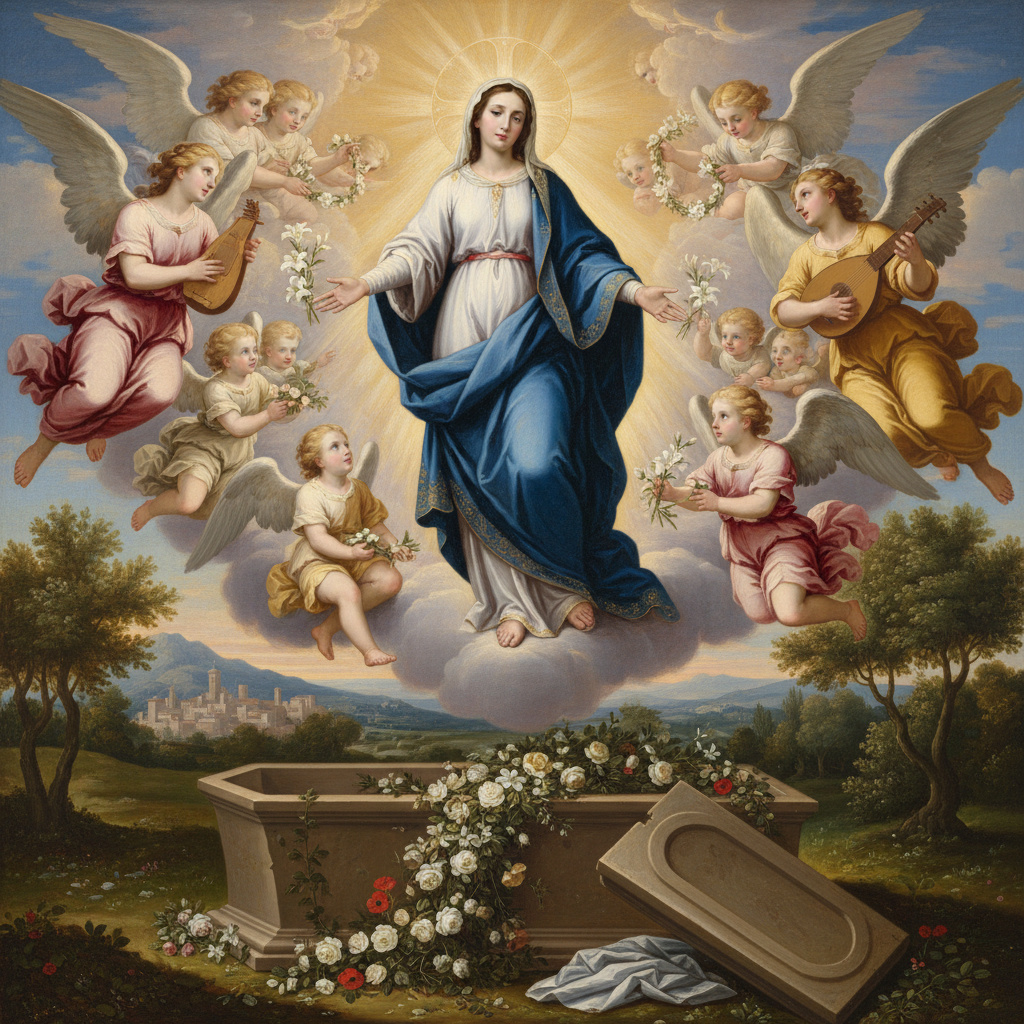
La Asunción: Consumación Gloriosa de la Redención Mariana y el Triunfo Escatológico de la Iglesia
La Asunción de la Santísima Virgen María no es una devoción piadosa opcional, sino la cumbre lógica y teológica de su inmaculada concepción y su maternidad divina, un dogma que proclama el triunfo anticipado de la redención en un ser humano y el destino glorioso de la Iglesia. Este artículo desentraña la ineludible verdad de la Asunción, arraigada en la Escritura, la Tradición y el Magisterio, como una declaración audaz de la victoria de Cristo sobre el pecado y la muerte.
6 mar 2026
Leer artículo
Análisis Apologético
Análisis Profundo: Dispute Over Traditional Latin Mass Restrictions Continues in Dioceses Worldwide
The theological perspective governing this analysis is rooted in a robust, yet nuanced, understanding of ecclesiology that synthesizes the Church's hierarchical structure with her mystical reality, her historical contingency with her eschatological destiny, and the divine mandate with human agency. It is a perspective that embraces the 'both/and' of Catholic thought: both the indefectibility of the Church and the fallibility of her human members; both the necessity of obedience to legitimate authority and the imperative of conscience formed by truth; both the perennial nature of tradition and its organic development. At its core is a Christocentric vision, where all ecclesial actions, including disciplinary ones, must ultimately serve the salvation of souls and the glorification of God, even when the means are imperfect or cause temporary distress. This perspective views the Church as a living organism, divinely instituted yet perpetually in need of purification, a *corpus permixtum* of saints and sinners, guided by the Holy Spirit through the vicissitudes of history. It recognizes that unity is not uniformity, but a profound communion in faith and love, which can accommodate a legitimate diversity of liturgical and spiritual expressions. Furthermore, it understands papal authority as a charism of service, exercised within the bounds of divine revelation and for the edification of the Body of Christ, not as an arbitrary power. The current dispute, from this perspective, is not merely a clash of preferences but a profound theological moment, a 'kairos' for the Church to re-examine her understanding of tradition, authority, unity, and the very nature of the sacred in a post-modern world. It is a call to deeper faith, greater charity, and a renewed commitment to the perennial truths of the Gospel, even when those truths manifest in challenging and unexpected ways within the life of the Church herself. This perspective ultimately affirms the Church's divine guidance and indefectibility, not by denying internal struggles, but by interpreting them as part of the ongoing process of sanctification and purification that prepares the Bride for her encounter with the Bridegroom.
6 mar 2026
Leer artículo
Teología
El Celibato Sacerdotal: Un Icono de la Escatología y la Plenitud del Reino
El celibato sacerdotal no es una mera disciplina eclesiástica, sino una profunda afirmación teológica y escatológica de la Iglesia. Es la respuesta radical a la llamada de Cristo, una consagración total que prefigura la vida del Reino y magnifica la fecundidad espiritual del ministerio. Lejos de ser una carga, es un don profético que testifica la soberanía de Dios sobre toda existencia humana.
6 mar 2026
Leer artículo

Análisis Apologético
Análisis Profundo: Pope Francis's 'Fiducia Supplicans' and its reception
The theological perspective underpinning *Fiducia Supplicans* is profoundly Augustinian, rooted in a radical understanding of the gratuity and primacy of grace over human merit, and a robust ecclesiology that views the Church as the universal sacrament of salvation, a 'locus of encounter' where the divine initiative perpetually seeks out and transforms fallen humanity. It is an eschatological perspective, holding in tension the 'already' of Christ's redemption and the 'not yet' of its full actualization in individual lives, seeing the blessing as a performative sign of this ongoing process. This perspective rejects any form of theological Pelagianism or semi-Pelagianism that would condition God's favor on pre-existing moral rectitude, asserting instead that grace is the *sine qua non* for any true moral striving or conversion. It embraces a 'theology of encounter' where divine truth is not merely a set of propositions, but a living Person (Christ) encountered in charity and mercy, which then illuminates and deepens understanding of doctrine. Furthermore, it is a 'kenotic ecclesiology,' recognizing that the Church, in its mission to embody Christ, must also embrace vulnerability, internal struggle, and the 'scandal' of engaging with the marginalized and 'irregular,' mirroring Christ's own self-emptying and association with sinners. This perspective affirms the *sensus fidei* as a pneumatic intuition of the Holy Spirit within the faithful, guiding the Magisterium in discerning new pastoral pathways for the application of immutable truths. Ultimately, it is a theology of radical hope and divine condescension, affirming that God's mercy is boundless, actively seeking out human brokenness not to condone it, but to transform it through the power of His unmerited love.
6 mar 2026
Leer artículo

Análisis Apologético
Análisis Profundo: Pope Francis Reiterates Stance on Homosexuality in Priesthood, Sparks Renewed Discussion
The theological perspective informing this analysis is rooted in a Christocentric, sacramental anthropology that understands the human person, particularly in vocational discernment, through the lens of creation, fall, and redemption. It emphasizes the ontological reality of the priesthood as an *alter Christus* configured to Christ the Head, Shepherd, and, crucially, the Bridegroom of the Church. This perspective asserts that human sexuality, as created by God, possesses an inherent teleology oriented towards procreation and the unitive love of a man and a woman within marriage, which serves as an icon of Christ's spousal relationship with the Church. Consequently, priestly celibacy is understood not as a mere disciplinary imposition but as a profound, positive embrace of spiritual fatherhood and a radical, eschatological self-gift, mirroring Christ's own spousal love for His Bride. From this vantage point, the Church's discernment regarding the suitability of men with deep-seated homosexual tendencies for the priesthood is not an act of discrimination but a prudential judgment, informed by both divine revelation and centuries of spiritual and psychological wisdom, concerning the holistic integration required for a man to live out the spousal and paternal dimensions of the priesthood fruitfully and without internal impediment. This perspective distinguishes between the inherent dignity of every human person, regardless of sexual orientation, and the specific spiritual and psychological demands of a particular sacred vocation, emphasizing that the Church's primary concern is the salvation and sanctification of souls, and the preservation of the integrity of the sacraments, rather than conformity to secular notions of inclusion or identity. It further posits that while grace perfects nature, it does not abolish it, necessitating a careful consideration of natural predispositions in vocational discernment for the sake of the individual's well-being and the efficacy of their ministry.
6 mar 2026
Leer artículo

Análisis Apologético
Análisis Profundo: German Synodal Way Continues Debates on Women's Ordination and LGBTQ+ Issues
The German Synodal Way, from a deep theological perspective, represents a profound crisis of *ecclesial pneumatology* and *Christological hermeneutics*. It manifests a dangerous drift towards a 'pneumatic reductionism,' where the Holy Spirit is perceived primarily as the animating force behind contemporary cultural shifts and sociological demands, rather than as the Paraclete who illuminates and vivifies the unchanging Deposit of Faith, drawing the Church into a deeper conformity with the revealed truth of Jesus Christ. This perspective risks divorcing the Spirit from the Incarnate Word, leading to an 'unmoored' pneumatology that prioritizes subjective experience and communal consensus over objective revelation and apostolic tradition. The core theological issue is a subtle but pervasive redefinition of *Tradition* itself. Instead of Tradition being understood as the living transmission of the entire truth of Christ, received from the Apostles and guarded by the Magisterium, it is re-imagined as a mutable historical process, perpetually open to fundamental revision based on contemporary societal pressures and perceived 'signs of the times' interpreted through a secular lens. This constitutes a direct challenge to the *sensus fidelium* as understood by the Church – not as a democratic barometer of popular opinion, but as the supernatural appreciation of the faith by the whole body of the faithful when guided by the Magisterium and in union with it. Furthermore, the Synodal Way's approach to sexual ethics and sacramental theology reveals a truncated *Christology* and a diminished *soteriology*. By seeking to bless same-sex unions or alter the understanding of ministerial priesthood based on secular notions of equality and inclusion, it implicitly diminishes the unique particularity of Christ's Incarnation and His spousal relationship with the Church. It risks reducing salvation from a radical transformation of human nature by grace to a mere affirmation of human desires and identities, thereby undermining the challenging yet liberating call to repentance, chastity, and conformity to Christ's own life. The Synodal Way, therefore, is not merely debating disciplinary matters; it is engaging in a fundamental re-evaluation of the Church's Christological identity, its pneumatological guidance, its understanding of Tradition, and its very mission as the sacrament of salvation in the world. It is a struggle between a Church that seeks to be relevant by conforming to the world and a Church that seeks to transform the world by remaining faithful to its divine constitution and revealed truth.
6 mar 2026
Leer artículo
Teología
El Celibato Sacerdotal: Voto de Amor Eucarístico y Victoria Escatológica
El celibato sacerdotal no es una mera disciplina eclesiástica, sino una expresión sublime de la consagración total a Cristo y a su Iglesia, un signo profético del Reino venidero y una profunda imitación del Señor mismo. Lejos de ser una carga o una reliquia del pasado, es una potencia espiritual que eleva el ministerio y configura al sacerdote como 'otro Cristo', plenamente disponible para la salvación de las almas.
6 mar 2026
Leer artículo

Análisis Apologético
Análisis Profundo: Archbishop Fernández Defends 'Fiducia Supplicans' Amidst Continued Global Resistance
The controversy surrounding *Fiducia Supplicans* compels a profound theological re-evaluation of the nature of blessing, grace, and the Church's eschatological mission, rooted in a nuanced Christological anthropology. From a deep theological perspective, *Fiducia Supplicans* can be understood as an attempt to articulate a 'proleptic eschatology of mercy' within the Church's pastoral practice. It posits that God's mercy, being prior to and foundational for His justice, does not wait for perfect conformity to truth before extending itself, but rather actively seeks out the disordered, the broken, and the marginalized, drawing them into a salvific encounter that *then* facilitates conversion and sanctification. This is not a dilution of truth but a profound affirmation of its ultimate purpose: to lead souls to God. The document implicitly embraces a 'kenotic ecclesiology,' where the Church, following Christ's self-emptying, humbles itself to meet humanity in its fallenness, offering a blessing that is not an endorsement of sin but a radical act of divine love reaching into the very heart of human brokenness. This blessing, while non-sacramental, functions as an 'anamnesis of divine desire' – a reminder that God desires the salvation of all and provides grace even in seemingly intractable situations. It is a performative utterance of hope, a spiritual 'first aid' administered to those who are spiritually wounded, preparing them for the full healing offered in the sacraments and a life in conformity with the Gospel. The resistance, particularly from regions deeply rooted in a holistic, integral anthropology, serves as a necessary theological counterpoint, demanding greater clarity on how this 'proleptic mercy' avoids the pitfalls of relativism or doctrinal indifferentism. It forces the Church to articulate with greater precision the distinction between 'blessing the sinner' and 'blessing the sin,' emphasizing that the former is a divine imperative, while the latter is an impossibility. The theological perspective here is one of 'incarnational realism,' acknowledging the objective reality of sin and disorder while simultaneously affirming the boundless, transformative power of God's grace to penetrate and redeem even the most challenging human situations. It is a call for the Church to embody Christ's radical compassion without compromising His radical call to holiness, understanding that true mercy always leads to truth, and true truth is always imbued with mercy. The controversy thus becomes a crucible for deepening the Church's understanding of its own identity as simultaneously a *mater et magistra* (mother and teacher), capable of both tender embrace and unwavering instruction, always guiding souls towards the *summum bonum* (highest good) of full communion with God.
6 mar 2026
Leer artículo
Teología
La Asunción: El Cénit Glorioso de la Redención, Inexpugnable Dogma de la Iglesia Eterna
La Asunción de la Santísima Virgen María no es un mero piadoso deseo, sino la culminación lógica y necesaria de la obra redentora de Cristo, un dogma inquebrantable que afirma la victoria total sobre el pecado y la muerte en el cuerpo de la Nueva Eva. Este artículo desentraña la profundidad teológica de la Asunción, demostrando su arraigo en la Escritura, la Tradición y el Magisterio, como testimonio irrefutable de la inmaculada santidad de María y la promesa escatológica para toda la Iglesia.
6 mar 2026
Leer artículo

Análisis Apologético
Análisis Profundo: Pope Francis Reiterates Stance on Homosexuality in Priesthood, Causes Stir with 'Faggotry' Remark
This incident must be viewed through the lens of *Incarnational Realism* and *Eschatological Tension*. The Church, as the Body of Christ, is not a disembodied ideal but a concrete, human-divine reality, always existing in the 'already but not yet' of the Kingdom. The Pope, as Vicar of Christ, embodies this tension most acutely. His humanity, with all its limitations and cultural baggage, is precisely where the divine grace of the Petrine office is made manifest, albeit imperfectly. This is not a flaw, but a profound theological truth: God works through fallen, imperfect human agents. The 'faggotry' remark, while regrettable and scandalous in a secular sense, forces a confrontation with the uncomfortable truth that the Church's language and actions, being human, will sometimes be jarring, offensive, or counter-cultural. This is part of its *scandalum crucis* – its inherent capacity to be a stumbling block to worldly wisdom. The controversy, therefore, becomes a crucible for faith, forcing believers to discern the enduring truth of Christ's presence and the Church's mission beyond the imperfections of its human instruments. It calls for a deeper understanding of the *kenotic* nature of the Church's mission, where divine power is often revealed through human weakness, and for a renewed commitment to charity and truth, even when they appear to be in tension. The ultimate theological perspective is one of purification: this painful episode serves as a catalyst for deeper introspection, humility, and a more authentic living out of the Gospel in a complex world, highlighting the Church's perennial need for conversion and sanctification, mirroring the journey of every individual soul.
6 mar 2026
Leer artículo

Análisis Apologético
Análisis Profundo: Pope Francis's 'Fiducia Supplicans' on Blessing Same-Sex Couples Continues to Spark Debate
The theological perspective underlying *Fiducia Supplicans* is rooted in a radical Christocentric anthropology and an eschatological understanding of grace. It posits that the human person, created in the *imago Dei* and redeemed by Christ, retains an inherent dignity and capacity for grace even in conditions of objective sin. This is not a Pelagian optimism but a profound conviction in the efficacy of Christ's universal salvific will and the Church's mission to be the sacrament of that salvation. The declaration implicitly re-centers the pastoral gaze from the 'state of the union' to the 'dignity of the person,' recognizing that grace operates not just through perfect conformity to law, but often through the messy, incremental process of conversion (*metanoia*) initiated by an encounter with unconditional love. It understands the blessing as a performative invocation of divine assistance, a tangible sign of God's prevenient grace, which precedes and enables human response. This perspective is deeply Trinitarian: the Father's boundless love, the Son's incarnate compassion, and the Spirit's transformative power are all manifested in the Church's maternal outreach. It is also profoundly ecclesiological, affirming the Church's identity as a 'field hospital' and a 'sacrament of salvation' for all humanity, not just the morally perfect. The eschatological dimension is crucial: the blessing, even in irregular situations, is a prophetic anticipation of the Kingdom, where all brokenness will be healed and all persons will be perfectly united with God. It is a gesture of hope, calling individuals towards the ultimate fulfillment of their human and spiritual potential in Christ, without compromising the objective truth of marriage, but rather by drawing individuals towards it through the pathway of mercy.
6 mar 2026
Leer artículo

Análisis Apologético
Análisis Profundo: German Synodal Way Continues to Spark Vatican Concerns Over Doctrinal Deviations
The German Synodal Way, when viewed through the lens of a robust Catholic ecclesiology, reveals a profound tension between an immanentist, anthropocentric understanding of the Church and a transcendent, Christocentric one. The underlying theological perspective that emerges from the Vatican's concerns is rooted in the conviction that the Church is not primarily a human institution subject to democratic reform or cultural adaptation, but rather a divinely instituted, sacramental reality – the Mystical Body of Christ and the living Temple of the Holy Spirit. This perspective emphasizes that the Church's authority, structure, and doctrinal content are not derived from human consensus or sociological trends, but from divine revelation, safeguarded by the Magisterium in unbroken apostolic succession. The Church's identity is fundamentally defined by its fidelity to Christ's institution and the deposit of faith, which transcends all temporal and cultural particularities. Therefore, any attempt to redefine fundamental doctrines, sacramental practices, or the hierarchical constitution of the Church based on contemporary societal pressures or a perceived 'will of the people' represents a subtle but significant departure from this foundational theological premise. It risks reducing the Church from a divinely guided, supernatural organism to a human organization, thereby undermining its unique claim to be the universal sacrament of salvation. This perspective insists on a hermeneutic of continuity, where doctrinal development deepens understanding without contradicting the immutable essence of revealed truth, and where the sensus fidei functions as a discerning recognition of truth, not a generative force for new doctrines. The unity of the Church, in this view, is not merely organizational but ontological, rooted in the unity of Christ Himself, and thus demands a universal coherence in faith, sacraments, and governance, safeguarded by the Petrine office.
6 mar 2026
Leer artículo

Análisis Apologético
Análisis Profundo: Archbishop Fernández's 'Fiducia Supplicans' Continues to Draw Criticism and Support
The theological perspective underpinning a robust apologetic for *Fiducia Supplicans* is rooted in a profound Christocentric anthropology, which posits that every human person, regardless of their moral state or relational configuration, is fundamentally a *capax Dei* – capable of God – and is called to holiness by virtue of their creation in the *imago Dei*. This perspective emphasizes that divine grace is not merely a reward for moral perfection, but a gratuitous gift offered universally, intended to heal, elevate, and transform the human person towards their ultimate eschatological destiny in Christ. It rejects a purely juridical or merit-based understanding of grace, instead affirming its radical gratuity and availability even to those in 'irregular situations.' This perspective views the Church not primarily as a gatekeeper of moral purity, but as the 'universal sacrament of salvation,' a field hospital that tends to the wounded and accompanies all souls on their journey towards God. It embraces a 'theology of encounter,' where the Church's mission is to meet individuals where they are, in their concrete realities, and to offer them the light of Christ's truth and the balm of His mercy. This involves a nuanced understanding of 'blessing' as distinct from 'sacrament' or 'approval,' recognizing that a blessing is fundamentally an invocation of divine favor upon the *person*, a prayer for their sanctification and conversion, rather than an endorsement of their lifestyle or relational status. Furthermore, this perspective is deeply informed by the 'hermeneutic of continuity' that seeks to understand how the Church's perennial truths can be articulated and applied pastorally in new historical and cultural contexts, without rupture but with dynamic fidelity. It acknowledges the tension between objective moral norms and subjective human experience, striving to uphold the former while compassionately accompanying the latter, recognizing that the path to holiness is often gradual and fraught with struggle. Ultimately, this theological perspective is one of radical trust in God's boundless mercy and His desire for the salvation of all humanity, viewing *Fiducia Supplicans* as a complex, perhaps imperfectly articulated, but fundamentally well-intentioned attempt to extend the Church's maternal embrace and the transformative power of grace to those on the peripheries, drawing them ever closer to the heart of Christ and His immutable truth.
6 mar 2026
Leer artículo

Análisis Apologético
Análisis Profundo: German Synodal Way Faces Renewed Vatican Scrutiny Over Doctrinal Issues
The German Synodal Way, when viewed through a robust Trinitarian and Christological lens, reveals a profound theological tension between an ecclesiology of divine institution and an ecclesiology of human construction. The Church, as the Mystical Body of Christ and the Temple of the Holy Spirit, is not primarily a human organization whose structures and doctrines are subject to continuous re-invention based on cultural pressures or democratic consensus. Rather, its very being, its hierarchical constitution, its sacramental economy, and its moral teachings are rooted in the eternal plan of God, revealed definitively in Jesus Christ and faithfully transmitted through Sacred Tradition and Scripture, interpreted by the living Magisterium. To attempt to 'democratize' the Church's governance, redefine its sexual ethics, or alter its understanding of the priesthood based on contemporary secular notions is to implicitly deny the Church's unique ontological status as a divine-human reality, a sacrament of salvation. Such an approach risks reducing the Church to a mere human association, thereby undermining its supernatural mission and its claim to possess unique, divinely revealed truth. The true path of synodality, therefore, must be understood as a deeper appropriation of communion, co-responsibility, and discernment *within* the divinely constituted framework of the Church, always in fidelity to the Petrine and episcopal ministries as guarantors of unity and truth, and never as a mechanism for doctrinal rupture or canonical revolution. The Vatican's scrutiny is thus a necessary defense of the Church's catholicity, its apostolicity, and its fidelity to Christ, safeguarding the integrity of the deposit of faith against a hermeneutic of discontinuity that threatens to fragment the Body of Christ.
6 mar 2026
Leer artículo

Análisis Apologético
Análisis Profundo: Pope Francis's Comments on Women Deacons Re-Ignite Debate
The theological perspective underpinning the Church's stance on women deacons is rooted in a profound *sacramental realism* and a *nuptial Christology* that views the Church not as a human institution subject to evolving social norms, but as a divinely instituted mystery, the Bride of Christ. This perspective understands the sacraments as efficacious signs that truly make present the reality they signify, drawing their power and meaning directly from Christ's Incarnation, Passion, and Resurrection. The maleness of the ordained minister in Holy Orders is not a sociological artifact but an integral part of this sacramental sign, reflecting Christ's unique identity as the Bridegroom and Head of the Church. This is not an argument about the inherent dignity or capabilities of women, which the Church affirms as equal to men, but about the specific *symbolic coherence* required for the sacrament to effectively signify Christ's spousal relationship with His Church. From this perspective, the diaconate, as the foundational degree of Holy Orders, shares in this male-specific sacramental signification, even if its primary function is service rather than the offering of the Eucharistic sacrifice. To introduce a female diaconate would therefore not be a mere administrative adjustment but a fundamental alteration of the sacramental sign, disrupting the ontological integrity of Holy Orders and obscuring the eschatological nuptial mystery that defines the Church's very being. This perspective insists that the Church cannot 'create' sacraments or alter their essential form, but must faithfully transmit what she has received, discerning the divine will as revealed in Scripture and Tradition, guided by the Holy Spirit.
6 mar 2026
Leer artículo
Teología
La Inquebrantable Cadena de Gracia: La Validez Sacramental en la Sucesión Apostólica como Pilar Indiscutible de la Iglesia
Este artículo desentraña la doctrina católica de la sucesión apostólica como el fundamento irrefutable de la validez sacramental, una verdad teológica que eleva a la Iglesia más allá de las fluctuaciones humanas y garantiza la presencia viva de Cristo en cada sacramento. Se argumenta con firmeza que la negación de esta sucesión no solo socava la gracia, sino que desmantela la misma estructura divina de la Iglesia, dejando a las comunidades sin la plenitud de los medios de salvación instituidos por Cristo.
6 mar 2026
Leer artículo
Teología
El Trono de Pedro: Roca Inquebrantable de la Unidad Católica y Escándalo para el Mundo
Este artículo profundiza en la ineludible verdad de la autoridad papal, no como una invención humana o una mera tradición, sino como el fundamento divinamente instituido para la unidad de la Iglesia de Cristo. Desafiando las objeciones seculares y protestantes, se demuestra cómo la primacía petrina, arraigada en la Escritura y la Tradición ininterrumpida, es la garantía de la indefectibilidad y la universalidad de la fe, una piedra de tropiezo para los que buscan una Iglesia fragmentada y un faro de verdad para los que anhelan la plenitud de la comunión.
6 mar 2026
Leer artículo

Análisis Apologético
Análisis Profundo: Archbishop Fernández's Continued Leadership of DDF Draws Criticism Amidst Theological Debates
The ongoing debates surrounding Cardinal Víctor Manuel Fernández's leadership of the DDF and its pronouncements, particularly 'Fiducia Supplicans,' reveal a profound theological tension between a static, propositional understanding of doctrine and a dynamic, pneumatological ecclesiology. From a deep theological perspective, this tension is not a sign of crisis but a manifestation of the Church's inherent vitality as a *mysterium lunae*, reflecting the light of Christ while navigating the phases of historical contingency. The Church, as the Bride of Christ, is not merely a custodian of fixed truths but a living organism animated by the Holy Spirit, continually guided 'into all truth' (John 16:13). This perspective emphasizes the *analogia fidei* as a dynamic process, where the perennial truths of Revelation are continually re-articulated and applied with renewed pastoral sensitivity, without compromising their essence. The DDF's work, especially under Cardinal Fernández, can be understood as an exercise in *pastoral epistemology*, where the Church seeks to know and apply divine truth not just intellectually, but empathetically, engaging with the complex realities of human experience. This involves a profound Christological imperative to accompany, bless, and invite, mirroring Christ's own ministry to sinners, rather than a purely juridical or exclusionary approach. The 'controversy' itself serves as an unintended apologetic, highlighting the Church's internal intellectual robustness and her capacity for self-critique, while simultaneously reaffirming the indispensable charism of the Petrine office as the visible principle of unity and guarantor of orthodoxy. The ultimate theological perspective here is one of *eschatological hope*, recognizing that the Church, in her earthly pilgrimage, is continually being purified and perfected by the Spirit, moving towards the fullness of the Kingdom. The DDF's efforts, therefore, are not merely administrative but deeply sacramental, mediating God's grace and truth to a world in need, even amidst the friction generated by human resistance to the Spirit's ongoing movement within the Body of Christ.
6 mar 2026
Leer artículo

Análisis Apologético
Análisis Profundo: German Synodal Way Continues to Face Vatican Scrutiny Over Doctrinal Deviations
The German Synodal Way, in its profound divergence from the Magisterium, reveals a fundamental crisis of theological anthropology, ecclesiology, and epistemology that challenges the very essence of Catholic identity. At its core, the Synodal Way implicitly proposes a radical re-anchoring of theological truth from its transcendent, revealed source – the *Logos* incarnate, mediated through Scripture and Tradition and authoritatively interpreted by the Magisterium – to an immanent, anthropocentric locus: the collective experience and democratic consensus of a particular cultural context. This constitutes a subtle but devastating hermeneutical shift. The Church, from this perspective, is no longer primarily the Mystical Body of Christ, the sacrament of salvation, or the custodian of immutable divine truth, but rather a human institution whose doctrines and practices are subject to evolution based on contemporary societal norms and perceived pastoral needs, as discerned through a process akin to secular democratic deliberation. This perspective fundamentally misunderstands the nature of revelation as a divine self-disclosure, not a human construct. It risks reducing the *depositum fidei* to a mutable cultural artifact rather than an unchangeable divine gift. The Synodal Way's proposals, particularly on women's ordination, LGBTQ+ inclusion, and priestly celibacy, are not merely disciplinary or pastoral adjustments; they are direct challenges to the Church's understanding of sacramental ontology, the metaphysics of human sexuality, and the eschatological dimension of the priesthood. They implicitly deny the iconic nature of the sacraments, which must signify what they contain, and the teleology of the human person as created in the *imago Dei* with a specific ordering towards God. Furthermore, the Synodal Way's methodology, emphasizing a 'listening process' and 'shared decision-making' that grants significant authority to lay participation, while laudable in its desire for greater inclusion, risks elevating sociological consensus above theological truth and the hierarchical structure divinely instituted by Christ. The Church is not a democracy in the secular sense; it is a *communio* structured by divine revelation and apostolic succession, where authority is exercised in service to truth, not derived from popular mandate. The Magisterium's role is not to invent new doctrines or to conform divine truth to human preferences, but to faithfully transmit, interpret, and defend the revealed truth. This crisis, therefore, is not merely about specific issues but about the very nature of authority within the Church, the sources of theological knowledge, and the ultimate purpose of the Church's existence. It forces a re-articulation of the Church's identity as the universal sacrament of salvation, transcending national boundaries and cultural particularities, united in faith, sacraments, and governance under the successor of Peter. The Vatican's scrutiny is thus not an act of authoritarian suppression but a necessary exercise of its Petrine charism to preserve the integrity of the *depositum fidei* and the unity of the Body of Christ, ensuring that the Church remains faithful to its divine founder and its salvific mission, rather than becoming a mere echo of the prevailing cultural zeitgeist.
6 mar 2026
Leer artículo

Análisis Apologético
Análisis Profundo: Archbishop Fernández's Defense of 'Fiducia Supplicans' Amidst Continued Resistance
The theological perspective underpinning a defense of *Fiducia Supplicans* as a legitimate pastoral development is rooted in a profound understanding of God's universal salvific will (1 Tim 2:4) and the Church's identity as the 'sacrament of salvation' (Lumen Gentium 1). This perspective emphasizes a 'Christological-pneumatological anthropology,' where every human person, regardless of their moral state or relational configuration, is seen as bearing the imago Dei and is therefore a recipient of God's antecedent love and salvific desire. The declaration, when properly understood, is not a modification of immutable doctrine concerning marriage or sexual morality, but rather a 'deepening' of the Church's understanding of grace, mercy, and pastoral accompaniment. It posits a distinction between 'liturgical blessings,' which are intrinsically linked to the Church's normative moral teachings and presuppose a state of grace or a desire for conformity, and 'pastoral blessings,' which are understood as spontaneous invocations of God's mercy upon individuals in their concrete, often imperfect, circumstances. These pastoral blessings are not an endorsement of a lifestyle or a relationship but a 'pre-sacramental' gesture, an outpouring of divine favor intended to draw individuals closer to Christ and His Church, thereby initiating or strengthening a path of conversion. This perspective aligns with a 'theology of encounter,' where the Church, following the example of Christ, goes out to meet individuals where they are, offering a bridge of grace before demanding full conformity. It views grace not merely as a reward for righteousness but as an enabling power that precedes and facilitates conversion. The resistance, while understandable from a perspective that prioritizes the defense of immutable moral doctrine, often overlooks this nuanced understanding of grace and the Church's maternal mission to all her children, particularly those on the peripheries. The theological challenge is to articulate how this 'pastoral mercy' is not a compromise of truth but an authentic expression of God's truth, which is ultimately merciful love. It requires a hermeneutic that embraces both continuity and legitimate development, recognizing the Holy Spirit's ongoing guidance of the Church in applying perennial truths to new pastoral realities, always ordered towards the ultimate flourishing and salvation of every human soul in Christ.
6 mar 2026
Leer artículo

Análisis Apologético
Análisis Profundo: Pope Francis's Comments on 'Gay Blessing' Document 'Fiducia Supplicans' Reaffirm Its Doctrinal Validity
The theological perspective underlying *Fiducia Supplicans* and its reaffirmation is a radical Christocentric anthropology rooted in an eschatological understanding of mercy. It posits that every human person, by virtue of their creation in the *imago Dei* and their redemption in Christ, possesses an inherent, inviolable dignity and an indelible orientation towards God, regardless of their current moral or existential state. This dignity is not contingent upon perfect adherence to moral law but is a foundational gift. The document views the human person not merely as a moral agent to be judged, but as a pilgrim soul on a journey towards ultimate communion with God, often marked by brokenness, sin, and 'irregular' situations. Mercy, therefore, is not merely a passive forgiveness of sin but an active, prevenient, and transformative divine energy that seeks out the lost, accompanies the struggling, and empowers conversion. It is an eschatological mercy, meaning it anticipates and works towards the full realization of God's kingdom, where all will be reconciled and perfected in Christ. The blessing, in this context, is a *sacramentale* of hope, a tangible expression of God's ongoing invitation to conversion and sanctification, offered to the person in their concrete reality, not as an endorsement of their choices, but as an invocation for grace to illuminate their path towards holiness. It reflects a theology that prioritizes the *person* over the *situation*, recognizing that God's love precedes and enables human transformation. This perspective also implicitly challenges a purely juridical or legalistic understanding of grace, emphasizing instead the dynamic, relational, and always-inviting nature of divine love, mediated through the Church's pastoral solicitude, under the Petrine charism of unity and discernment.
6 mar 2026
Leer artículo

Análisis Apologético
Análisis Profundo: Pope Francis's Remarks on 'Gay Lobby' in the Vatican Spark Debate
The theological perspective informing this analysis is rooted in a robust understanding of the Church as a supernatural organism, continually engaged in spiritual warfare against forces that seek to corrupt its doctrine and practice. It emphasizes the unique charism of the Petrine office, not merely as an administrative function but as a prophetic and pastoral guardianship of the *depositum fidei* and the sanctity of the clergy. This perspective views the priesthood as an ontological transformation into *alter Christus*, demanding a radical conformity to Christ the Bridegroom, and sees celibacy not as a mere discipline but as an eschatological sign. It understands 'lobbies' or 'subcultures' within the Church, particularly those challenging settled doctrine on sexuality, as manifestations of the 'spirit of the age' attempting to infiltrate and undermine the Church's divine mission. True pastoral care, from this perspective, often necessitates speaking uncomfortable truths and setting clear boundaries, even at the cost of immediate popular approval, for the ultimate salvation of souls and the integrity of the Body of Christ. The controversy itself is thus reframed as a providential opportunity for purification and deeper catechesis, affirming the Church's counter-cultural witness in a world increasingly hostile to revealed truth.
6 mar 2026
Leer artículo

Análisis Apologético
Análisis Profundo: German Synodal Way's Continued Push for Reforms Despite Vatican Concerns
The theological perspective governing this analysis is rooted in a robust Trinitarian-Christological ecclesiology, where the Church is understood as the Mystical Body of Christ, animated by the Holy Spirit, and participating in the divine life. This perspective emphasizes the Church's supernatural origin and destiny, viewing it not primarily as a human organization or a democratic assembly, but as a divinely instituted 'sacrament of salvation' – a visible sign and instrument of communion with God and among men. Revelation is understood as an objective, transcendent truth given by God, entrusted to the Church's Magisterium for faithful interpretation and transmission, not subject to redefinition by cultural trends or national consensus. Sacraments are seen as efficacious signs instituted by Christ, whose validity and fruitfulness depend on their fidelity to divine institution and apostolic tradition, not on human adaptation. The Petrine ministry and the hierarchical structure are viewed as divinely willed safeguards for the Church's unity in faith and governance, ensuring its catholicity against fragmentation. This perspective champions a 'hermeneutic of continuity' in theological development, where genuine growth in understanding always respects and builds upon the foundational deposit of faith, rather than effecting a rupture with it. Ultimately, the Church's mission is understood as eschatological, pointing humanity towards its ultimate destiny in God, and therefore its teachings and disciplines often provide a counter-cultural witness to the primacy of the spiritual and the eternal, challenging the immanentist and secularizing tendencies of the age.
6 mar 2026
Leer artículo

Teología
La Asunción de la Santísima Virgen María: El Triunfo Escatológico de la Gracia y la Consumación de la Redención Humana en la Madre de Dios
La Asunción de María no es una devoción secundaria, sino la piedra angular que revela la plenitud de la redención de Cristo, la victoria sobre el pecado y la muerte, y el destino glorioso de la Iglesia. Este dogma, enraizado en la Escritura y la Tradición ininterrumpida, proclama la consumación de la gracia en la Madre Inmaculada y anticipa la resurrección final de todos los justos, ofreciendo una visión profunda del plan divino para la humanidad.
6 mar 2026
Leer artículo

Teología
El Purgatorio: La Ineludible Lógica de la Santidad Divina y la Misericordia Perfecta
Este artículo desentraña la verdad del Purgatorio no como una invención tardía o un castigo arbitrario, sino como la manifestación necesaria de la justicia y la misericordia de Dios, una doctrina arraigada en la Escritura, la Tradición ininterrumpida y la razón misma. Es el crisol de la purificación que prepara al alma para la visión beatífica, un testimonio de la santidad inmaculada de Dios y de su amor que no deja nada imperfecto.
6 mar 2026
Leer artículo
La Cátedra de Pedro: Fundamento Bíblico e Histórico de la Autoridad Papal
La autoridad papal, piedra angular de la Iglesia Católica, es a menudo objeto de malentendidos y controversias. Este artículo explora sus raíces bíblicas, su desarrollo histórico y su significado teológico, defendiendo su legitimidad como institución divinamente establecida para preservar la unidad y la verdad de la fe cristiana.
6 mar 2026
Leer artículo
La Asunción de María: Un Dogma de Fe, Historia y Esperanza
La Asunción de María al cielo, cuerpo y alma, es un dogma de fe que resuena con profundas implicaciones teológicas y espirituales. Este artículo explora sus raíces bíblicas y patrísticas, su desarrollo histórico, su proclamación dogmática, y su significado para la fe cristiana, defendiendo su coherencia y su lugar esencial en la soteriología y la escatología.
6 mar 2026
Leer artículo
Doctrina
El Celibato Sacerdotal Católico: Un Tesoro Teológico y Pastoral en la Tradición Apostólica
El celibato sacerdotal en la Iglesia Católica no es una mera disciplina eclesiástica arbitraria, sino una profunda expresión teológica y pastoral arraigada en la tradición apostólica, la imitación de Cristo y la escatología del Reino. Este artículo explora sus fundamentos bíblicos, históricos, teológicos y pastorales, defendiendo su valor intrínseco como un don para la Iglesia y el mundo.
6 mar 2026
Leer artículo
Doctrina
La Asunción de María: Un Dogma de Fe con Profundas Raíces Bíblicas, Teológicas e Históricas
La Asunción de la Santísima Virgen María al cielo en cuerpo y alma es un dogma fundamental de la fe católica, proclamado solemnemente por el Papa Pío XII en 1950. Lejos de ser una invención moderna, esta creencia se asienta sobre siglos de tradición, profundas intuiciones teológicas y una coherencia innegable con la revelación bíblica sobre la gracia de Dios y el destino final de la humanidad. Este artículo explorará las múltiples facetas de este dogma, desentrañando sus fundamentos escriturísticos implícitos, su desarrollo patrístico y litúrgico, su significado teológico y su relevancia para la vida del creyente hoy.
6 mar 2026
Leer artículo
La Veneración de los Santos en la Tradición Católica: Fundamentos Bíblicos, Históricos y Teológicos
Este artículo examina la veneración de los santos en la Iglesia Católica, desglosando sus raíces bíblicas, desarrollo histórico y articulación teológica. Se refutan objeciones comunes y se subraya su papel como intercesores y modelos de fe.
6 mar 2026
Leer artículo
La Sola Gratia y la Soteriología Católica: Una Defensa Apologética de la Gracia Cooperativa
Este artículo explora la soteriología católica frente al principio protestante de la Sola Gratia, defendiendo la doctrina de la gracia cooperativa y la sinergia divino-humana en la salvación.
6 mar 2026
Leer artículo
El Concilio Vaticano II: Continuidad, Renovación y Apologética de la Fe Católica
Análisis profundo del Concilio Vaticano II, explorando su continuidad con la tradición, su renovación pastoral y litúrgica, y refutando críticas desde una perspectiva apologética católica. Se examina su impacto doctrinal e histórico.
6 mar 2026
Leer artículo
La Gracia en la Salvación: Una Perspectiva Católica sobre la Sola Gratia
Este artículo explora la doctrina de la gracia en la salvación desde una perspectiva católica, contrastándola y refutando la interpretación protestante de la 'Sola Gratia'. Se examina la primacía absoluta de la gracia divina, su relación intrínseca con la cooperación humana y las obras, y su manifestación en los sacramentos, ofreciendo un análisis bíblico, histórico y doctrinal.
6 mar 2026
Leer artículo
Justificación por la Fe y las Obras: Una Perspectiva Católica Integral
Este artículo examina la doctrina católica de la justificación, contrastándola con la 'Sola Fide'. Analiza la Escritura, la Tradición y el Magisterio, refutando objeciones protestantes y destacando la sinergia de fe y obras.
6 mar 2026
Leer artículo
El Celibato Sacerdotal Católico: Fundamentos Teológicos, Históricos y Apologéticos de una Disciplina Eclesial
Exploración profunda del celibato sacerdotal católico, abordando sus raíces bíblicas, desarrollo histórico, fundamentos teológicos y su defensa apologética frente a críticas.
6 mar 2026
Leer artículo
La Comunión de los Santos: Una Profunda Realidad Eclesiológica y Apologética
Este artículo explora la doctrina católica de la Comunión de los Santos, analizando sus fundamentos bíblicos, desarrollo histórico y articulación doctrinal, mientras refuta objeciones comunes.
6 mar 2026
Leer artículo
El Concilio Vaticano II: Continuidad, Renovación y Apologética de la Tradición Viva
Análisis profundo del Concilio Vaticano II, desmitificando interpretaciones erróneas y defendiendo su continuidad con la tradición, su renovación pastoral y su relevancia apologética frente a críticas.
6 mar 2026
Leer artículo
El Purgatorio: Una Doctrina de Misericordia y Justicia Divina
Este artículo explora la doctrina católica del Purgatorio a través de un análisis bíblico, histórico y doctrinal, defendiéndola frente a críticas y destacando su coherencia con la justicia y misericordia divinas.
6 mar 2026
Leer artículo
La Doctrina Católica de las Indulgencias: Una Perspectiva Teológica, Histórica y Apologética
Este artículo explora la doctrina católica de las indulgencias desde una perspectiva teológica, histórica y apologética, desmitificando conceptos erróneos y presentando su fundamento bíblico y magisterial.
6 mar 2026
Leer artículo
La Sola Scriptura y la Tradición Apostólica: Un Análisis Apologético Católico
Este artículo examina críticamente la doctrina protestante de la Sola Scriptura frente a la comprensión católica de la Escritura y la Tradición Apostólica como fuentes de revelación divina.
6 mar 2026
Leer artículo
La Confirmación: Sellado del Espíritu y Plenitud de la Gracia Bautismal
Este artículo explora la Confirmación como sacramento fundamental de la iniciación cristiana, analizando sus raíces bíblicas, desarrollo histórico, teología dogmática y su rol apologético frente a objeciones.
6 mar 2026
Leer artículo
La Validez de los Sacramentos en la Iglesia Católica: Una Defensa Teológica y Apologética
Este artículo explora la validez de los sacramentos católicos, examinando sus fundamentos bíblicos, desarrollo histórico y articulación doctrinal, refutando objeciones comunes.
6 mar 2026
Leer artículo
El Purgatorio: Purificación Escatológica y Misericordia Divina en la Teología Católica
Este artículo explora la doctrina católica del Purgatorio, analizando sus fundamentos bíblicos, desarrollo histórico y articulación doctrinal. Se defiende su coherencia teológica frente a objeciones, destacando su rol como expresión de la justicia y misericordia divinas.
6 mar 2026
Leer artículo
El Bautismo de Infantes: Una Defensa Apologética Católica de la Gracia Primordial
Este artículo ofrece una defensa teológica, bíblica e histórica del bautismo de infantes en la Iglesia Católica, refutando objeciones comunes y destacando su fundamento en la gracia.
6 mar 2026
Leer artículo
La Justificación por la Fe y las Obras: Una Perspectiva Católica Integral Frente al Sola Fide
Este artículo examina la doctrina católica de la justificación, contrastándola con la 'Sola Fide' protestante. Se analiza la Escritura, la tradición patrística y el Magisterio para demostrar que la fe y las obras son inseparables en el proceso salvífico.
6 mar 2026
Leer artículo
El Sacramento de la Penitencia y la Reconciliación: Fundamentos Bíblicos, Históricos y Doctrinales de la Misericordia Divina
Este artículo explora el Sacramento de la Penitencia y la Reconciliación, analizando sus profundas raíces bíblicas, su desarrollo histórico y su sólida base doctrinal. Se refutan objeciones comunes y se destaca su papel central en la economía de la salvación.
6 mar 2026
Leer artículo
La Pedobautismo Católico: Una Defensa Teológica, Bíblica e Histórica del Bautismo de Infantes
Este artículo ofrece una defensa exhaustiva del bautismo de infantes en la Iglesia Católica, examinando sus fundamentos bíblicos, desarrollo histórico y profunda coherencia doctrinal.
6 mar 2026
Leer artículo
La Confirmación: Sacramento de Plenitud y Misión en la Apologética Católica
Análisis profundo de la Confirmación como sacramento de iniciación cristiana, fundamentado en la Escritura, la Tradición y el Magisterio, refutando objeciones protestantes y destacando su rol en la misión de la Iglesia.
6 mar 2026
Leer artículo
El Purgatorio: Una Doctrina de Misericordia Divina y Purificación Escatológica
Este artículo explora la doctrina católica del Purgatorio a través de un análisis bíblico, histórico y doctrinal, refutando objeciones y presentando su fundamento en la justicia y misericordia divinas.
6 mar 2026
Leer artículo
La Comunión de los Santos: Una Defensa Apologética de la Unidad Eclesial Transcendente
Este artículo explora la doctrina católica de la Comunión de los Santos, analizando sus fundamentos bíblicos, desarrollo histórico y articulación doctrinal. Se refutan objeciones protestantes y se subraya su papel esencial en la eclesiología.
6 mar 2026
Leer artículo
La Comunión de los Santos: Una Apología Católica de la Unidad Eclesial Transcendente
Este artículo explora la doctrina católica de la Comunión de los Santos, analizando sus fundamentos bíblicos, desarrollo histórico y articulación teológica. Refuta objeciones protestantes y subraya su centralidad en la fe.
6 mar 2026
Leer artículo
La Infalibilidad Papal: Un Pilar de la Verdad Divinamente Garantizado
Este artículo explora la doctrina católica de la infalibilidad papal, analizando sus fundamentos bíblicos, desarrollo histórico y articulación dogmática, refutando objeciones comunes.
6 mar 2026
Leer artículo
La Cátedra de Pedro: Fundamentos Bíblicos, Históricos y Doctrinales de la Autoridad Papal
Este artículo explora la autoridad papal desde sus raíces bíblicas, su desarrollo histórico y su articulación doctrinal, refutando objeciones comunes y afirmando su rol esencial en la unidad y verdad de la Iglesia Católica.
6 mar 2026
Leer artículo
El Purgatorio: Una Verdad de Fe Católica Fundamentada en la Escritura, la Tradición y la Razón
Este artículo explora la doctrina católica del Purgatorio, un estado de purificación final para aquellos que mueren en gracia de Dios pero aún necesitan expiar pecados veniales o penas temporales. Se analiza su fundamento bíblico, desarrollo histórico, articulación doctrinal y refutación de objeciones.
6 mar 2026
Leer artículo
La Paternidad Divina y la Inclusión en la Alianza: Una Defensa Apologética del Bautismo de Infantes
Este artículo profundiza en la justificación teológica, bíblica e histórica del bautismo de infantes en la Iglesia Católica, refutando objeciones comunes y afirmando su coherencia con la economía de la salvación.
6 mar 2026
Leer artículo
La Indulgencia en la Práctica Católica: Una Defensa Teológica y Apologética
Este artículo examina la doctrina y práctica de las indulgencias en la Iglesia Católica, desmitificando conceptos erróneos y ofreciendo una defensa teológica rigurosa basada en la Escritura, la Tradición y el Magisterio.
6 mar 2026
Leer artículo
El Concilio Vaticano II: Continuidad, Renovación y Apologética de la Tradición Católica
Este artículo examina el Concilio Vaticano II desde una perspectiva apologética, destacando su continuidad con la tradición, su renovación pastoral y su respuesta a los desafíos modernos, refutando críticas sobre una supuesta ruptura doctrinal.
6 mar 2026
Leer artículo
La Reforma Protestante: Una Evaluación Apologética Católica de sus Críticas y Legado
Este artículo ofrece una profunda evaluación apologética católica de la Reforma Protestante, analizando sus fundamentos doctrinales, históricos y bíblicos, y refutando sus críticas a la Iglesia.
6 mar 2026
Leer artículo
El Concilio Vaticano II: Continuidad, Renovación y la Defensa Apologética de su Legado
Análisis profundo del Concilio Vaticano II, explorando su continuidad con la Tradición, las reformas litúrgicas y eclesiológicas, y refutando críticas desde una perspectiva apologética católica.
6 mar 2026
Leer artículo

Cisma
La Abismal Diferencia: División Protestante vs Conflictos Internos Católicos
Existe una distinción teológica fundamental que los protestantes ignoran: la división protestante es inherente a su naturaleza, mientras que los conflictos católicos son desviaciones de la unidad esencial de la iglesia.
6 mar 2026
Leer artículo

Autoridad
Autoridad Papal: El Fundamento de la Unidad Católica
La autoridad del Papa no es un invento medieval sino un mandato directo de Cristo. Mateo 16:18 establece la base teológica para el primado de Pedro y sus sucesores.
5 mar 2026
Leer artículo
Reforma
Vaticano II: ¿Reforma Necesaria o Ruptura Peligrosa?
El Concilio Vaticano II fue un evento transformador que dividió opiniones. Mientras algunos lo ven como una apertura necesaria, otros lo consideran una ruptura con la tradición.
4 mar 2026
Leer artículo

Sacramentos
La Validez de los Sacramentos: Una Defensa Teológica
Los sacramentos católicos son válidos incluso cuando son administrados por sacerdotes indignos. Esta es una verdad fundamental que distingue la teología católica de otras tradiciones.
3 mar 2026
Leer artículo
Mariología
Marianismo Católico: Defensa contra Críticas Protestantes
El culto a María en la iglesia católica no es idolatría sino veneración. Existe una diferencia teológica crucial entre adoración (latría) y veneración (dulía).
2 mar 2026
Leer artículo
Updated Title
Test excerpt
Leer artículo
Updated Title
Test excerpt
Leer artículo
Updated Title
Test excerpt
Leer artículo
Updated Title
Test excerpt
Leer artículo
Updated Title
Test excerpt
Leer artículo
Updated Title
Test excerpt
Leer artículo
Updated Title
Test excerpt
Leer artículo
Updated Title
Test excerpt
Leer artículo
Updated Title
Test excerpt
Leer artículo
Updated Title
Test excerpt
Leer artículo
Updated Title
Test excerpt
Leer artículo
Updated Title
Test excerpt
Leer artículo
Updated Title
Test excerpt
Leer artículo
Updated Title
Test excerpt
Leer artículo
Updated Title
Test excerpt
Leer artículo
Updated Title
Test excerpt
Leer artículo
Updated Title
Test excerpt
Leer artículo
Updated Title
Test excerpt
Leer artículo
Updated Title
Test excerpt
Leer artículo
Updated Title
Test excerpt
Leer artículo
Updated Title
Test excerpt
Leer artículo
Updated Title
Test excerpt
Leer artículo
Updated Title
Test excerpt
Leer artículo
Updated Title
Test excerpt
Leer artículo
Updated Title
Test excerpt
Leer artículo
Profundiza tu Conocimiento
Explora nuestros artículos y entrenamientos para una formación católica completa.
100%